
Complete denture stages
The clinical sequence is a chain of information. Check each record before it becomes the foundation of the next stage.
Quick revision summary
Verify each transferred record
Tray extension, tissue recording and stable jaw-registration bases influence every later stage. Correct the cause of an unreliable record rather than hoping processing or adjustment will compensate.
Use the trial actively
Check jaw relationship, vertical dimension, tooth display, lip support, speech and contacts. Make changes with the patient before processing; approval should follow a real clinical assessment.
Review the finished result
Recheck seating, borders and occlusion after processing. Explain adaptation and cleaning and provide a review route; persistent pain or an atypical lesion needs investigation rather than indefinite tolerance.
Common mistake
An unstable record base cannot produce a reliable jaw registration, even if the laboratory mounts the supplied record accurately.
Complete denture stages
The clinical sequence is a chain of information. Check each record before it becomes the foundation of the next stage.
Clinical and laboratory sequence
| Stage | Essential information | Check before progressing |
|---|---|---|
| Primary impression | Arch form and denture-bearing area for assessment and tray construction | Relevant anatomy is captured without major distortion. |
| Custom tray and definitive impression | Appropriate supporting surfaces and functional boundaries | Tray clearance, extension, border recording and impression quality are suitable. |
| Jaw registration | Reproducible interarch relationship, vertical dimension and aesthetic guidance | Record bases are stable; repeated closure gives consistent results. |
| Wax trial | Tooth position, appearance, speech and occlusal relationships | Patient and clinician can assess and correct the arrangement before processing. |
| Insertion and review | Fit, function and the patient’s ability to use the finished prosthesis | Tissue pressure, borders, contacts and aftercare are checked. |
Primary impressions for complete dentures
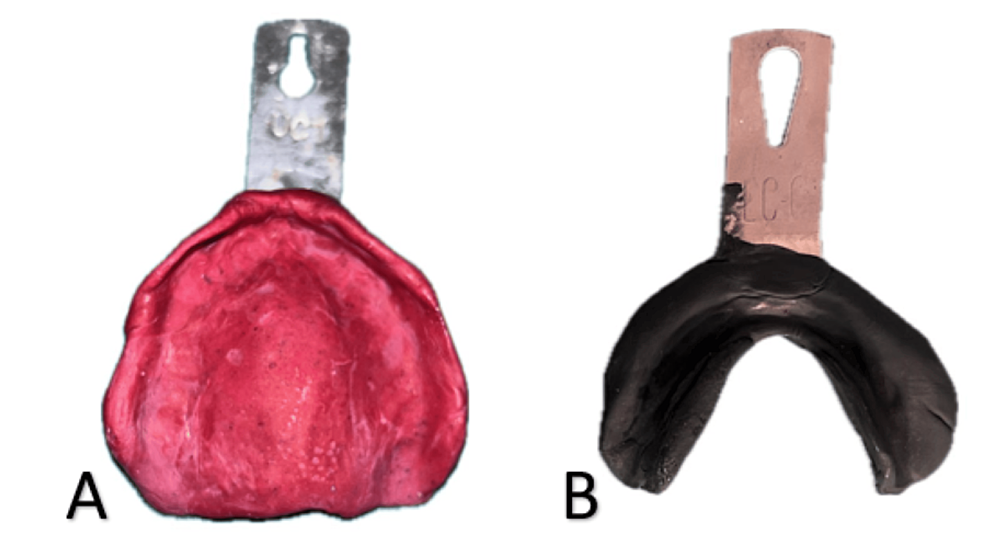
Upper and lower preliminary records from the same case. The materials illustrate this author’s technique rather than a required material choice for every patient.
Panel key
- A
- Maxillary impression in impression compound.
- B
- Mandibular impression using an admix material.
Refining Complete Dentures — figure 3 · Rucha Chiddarwar, Anjali Bhoyar, Surekha A. Dubey, Mithilesh M. Dhamande and Sheetal R. Khubchandani · CC BY 4.0. Original published figure reproduced without alteration; panel letters and labels retained.
Impressions: extension without displacement
Inspect the primary casts before prescribing the tray. Tray design, spacer, stops and handle position should suit the chosen material and tissue strategy. A bulky handle can distort the lip or prevent functional movements. Check tray extension clinically; a cast does not fully reveal the movement of the floor of the mouth or the activity of the cheeks.
Border recording aims to define a useful functional extent. Underextension sacrifices support or seal; overextension can dislodge the denture and traumatise mucosa. Choose how to record mobile tissue and relieve vulnerable areas. Inspect the completed impression for voids, pulls, tray show-through, border defects and displacement. Repeating an inadequate record is usually more predictable than asking the laboratory to infer missing anatomy.
Definitive impressions: upper and lower arches
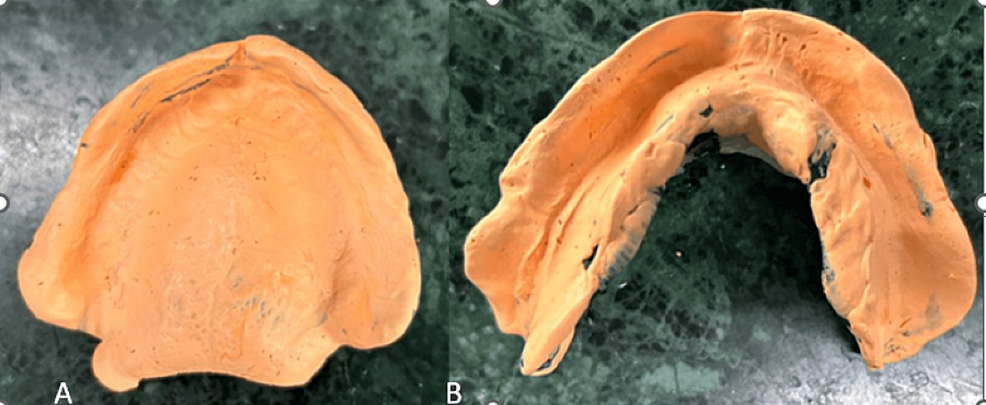
Final impressions from the source case. Compare their coverage and borders with the preliminary records, alongside the chapter’s impression checks.
Panel key
- A
- Maxillary definitive impression.
- B
- Mandibular definitive impression.
Refining Complete Dentures — figure 4 · Rucha Chiddarwar, Anjali Bhoyar, Surekha A. Dubey, Mithilesh M. Dhamande and Sheetal R. Khubchandani · CC BY 4.0. Original published figure reproduced without alteration; panel letters and labels retained.
Jaw registration depends on stable bases
A wax rim that moves during closure cannot provide a dependable jaw relationship. Check the record bases for support and stability before altering the rims. Establish lip support, tooth display, occlusal plane and vertical dimension using several clinical observations. Mark useful aesthetic information and communicate the intended tooth arrangement, shade and shape.
Rehearse a repeatable closure rather than forcing the mandible backwards. Verify the relationship more than once and consider whether pain, fatigue, unstable bases or habitual denture contacts are influencing the record. If the relationship changes at the trial, recheck the foundations before adjusting every tooth to a possibly erroneous record.
Use the wax trial as a genuine decision point
Assess frontal and profile appearance, lip support, smile line, midline, incisal display and the patient’s preferences. Listen to speech with the trial in place. Check closure and contacts with the bases seated; a wax trial can itself be unstable, so distinguish base movement from an arrangement error. Confirm the patient understands that processing may still require clinical adjustment.
Record agreed changes explicitly. Aesthetic approval does not establish an accurate jaw relationship, and the clinician remains responsible for functional checks. Resolve important discrepancies while the teeth remain in wax. Avoid proceeding simply because the patient wants the treatment finished quickly.
Wax try-in: trial tooth arrangement
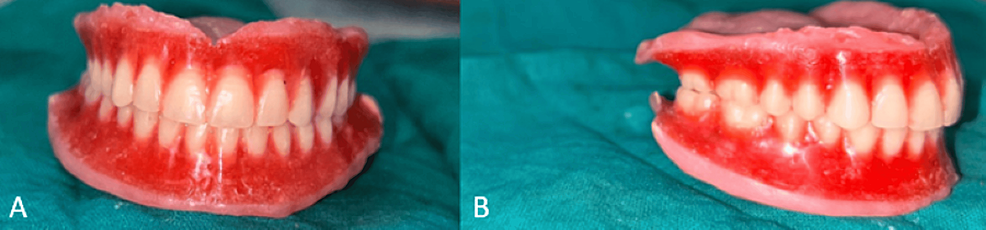
The trial dentures still have wax bases. Connect the tooth arrangement with checks of appearance, speech, jaw relationship and patient preferences before processing.
Panel key
- A–B
- Two views of the trial tooth arrangement in wax.
Refining Complete Dentures — figure 6 · Rucha Chiddarwar, Anjali Bhoyar, Surekha A. Dubey, Mithilesh M. Dhamande and Sheetal R. Khubchandani · CC BY 4.0. Original published figure reproduced without alteration; panel letters and labels retained.
Palatogram: checking tongue contact during speech
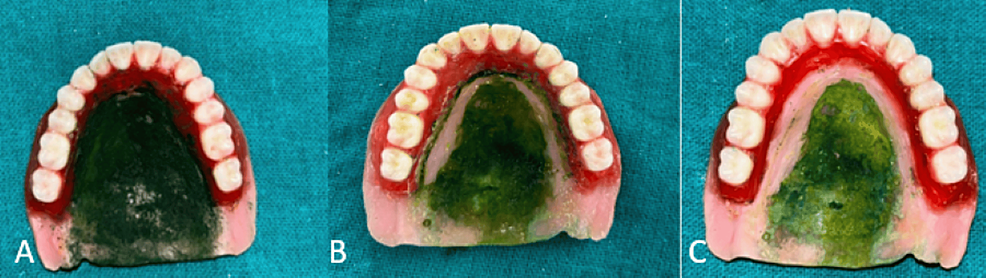
A specialist speech assessment used in this case. The palatal marking records tongue contact; it is separate from checking the denture’s fitting surface.
Panel key
- A
- Marking applied to the palatal surface.
- B
- Contact pattern with the initial contour.
- C
- Pattern after selective palatal correction.
Refining Complete Dentures — figure 7 · Rucha Chiddarwar, Anjali Bhoyar, Surekha A. Dubey, Mithilesh M. Dhamande and Sheetal R. Khubchandani · CC BY 4.0. Original published figure reproduced without alteration; panel letters and labels retained.
Processing and the finished acrylic dentures
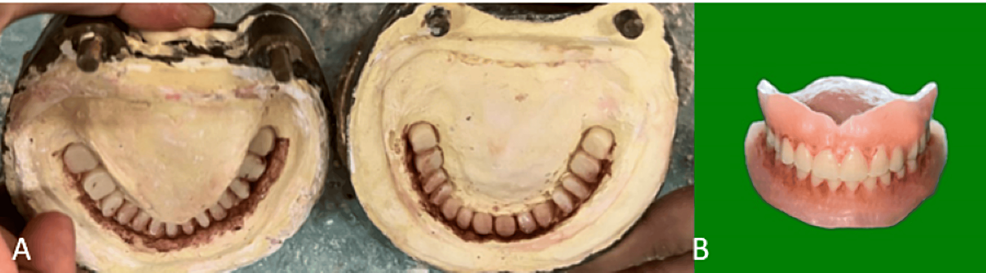
The source illustrates aesthetic characterisation during processing and the completed dentures. This is one case example, not a photograph of every laboratory step.
Panel key
- A
- Characterisation stains placed in the mould.
- B
- Finished dentures with characterised acrylic.
Refining Complete Dentures — figure 8 · Rucha Chiddarwar, Anjali Bhoyar, Surekha A. Dubey, Mithilesh M. Dhamande and Sheetal R. Khubchandani · CC BY 4.0. Original published figure reproduced without alteration; panel letters and labels retained.
Insertion, advice and review
Use pressure-indicating material and functional movements to identify fitting or border problems, then assess occlusion with the bases fully seated. Do not assume every sore area is caused by a high spot in the fitting surface: a premature contact may tip the denture repeatedly onto that area. Give practical advice on insertion, removal, cleaning, eating and overnight removal in the patient’s circumstances.
Arrange review for adaptation and tissue response. Ask the patient to identify the task that still causes difficulty. Persistent ulceration, swelling or an unexplained lesion requires assessment beyond routine denture adjustment. Document alterations so the next clinician can understand what has changed and why.
Know what each transfer can and cannot preserve
An impression transfers tissue form; a jaw record transfers a relationship; the trial arrangement tests position, appearance and function. Each has its own potential error. A digitally stored record can be useful for future reproduction, but it also preserves mistakes if the clinical stage was inaccurate.
At every handover, communicate which features have been verified and which remain provisional. For example, a pleasing tooth arrangement mounted on unstable bases cannot validate the jaw relationship. The clinician remains responsible for accepting the record and finished result rather than treating laboratory completion as clinical approval.
A distinction to remember
An unstable record base cannot produce a reliable jaw registration, even if the laboratory mounts the supplied record accurately.
The record base rocks during jaw registration. What should happen before recording the bite?
Reveal the reasoning
Correct or replace the unstable base and establish reliable seating. A shifting base can produce a false jaw relationship and misleading tooth setup. Repeating the closure record without addressing movement simply records the same uncertainty again.
Guidance to read alongside this chapter
Test your recall
What is the purpose of a primary denture impression?
Show answer
It records enough anatomy to plan and make an appropriate special tray and preliminary cast. It must include the required supporting and limiting tissues. A grossly distorted or underextended primary record can compromise later stages even if the definitive material is accurate.