
Cardiovascular disease
Determine the specific cardiac condition, its current stability and its relevance to the proposed procedure. Bleeding management, physiological tolerance and infective-endocarditis prevention are separate questions that need separate answers.
Quick revision summary
Assess current cardiac stability
Ask about chest pain, breathlessness, orthopnoea, syncope, recent admission and changing exercise tolerance. The present symptom pattern determines urgency and setting more usefully than a historical cardiac label or one normal observation.
Separate the cardiac precautions
Antithrombotic management, device compatibility and infective-endocarditis prophylaxis are distinct decisions. A coronary stent does not itself require prophylaxis, while its antiplatelet treatment can be essential and must not be interrupted casually.
Use the current endocarditis pathway
Establish the exact cardiac risk category and procedure. SDCEP recommends offering prophylaxis to high-risk patients before extraction or oral surgery, with shared decisions and current prescribing checks for the individual situation.
Common mistake
Do not confuse a coronary stent or pacemaker with a prosthetic heart valve, or treat “not routinely” as a universal prohibition on prophylaxis.
Cardiovascular disease
Determine the specific cardiac condition, its current stability and its relevance to the proposed procedure. Bleeding management, physiological tolerance and infective-endocarditis prevention are separate questions that need separate answers.
Identify the condition and the current symptoms
Clarify whether the history concerns coronary disease, heart failure, arrhythmia, valve disease, congenital disease or a device. Ask about recent admissions, interventions, chest pain, exertional breathlessness, orthopnoea, syncope and change from usual exercise tolerance. Record relevant medicines and the treating team. Stable symptoms under an established plan differ from pain occurring at rest or rapidly worsening breathlessness. One normal pulse or blood-pressure reading cannot establish stability. A history of a pacemaker does not explain every episode of collapse and does not by itself identify the patient’s infective-endocarditis risk category.
Electrical conduction system of the heart
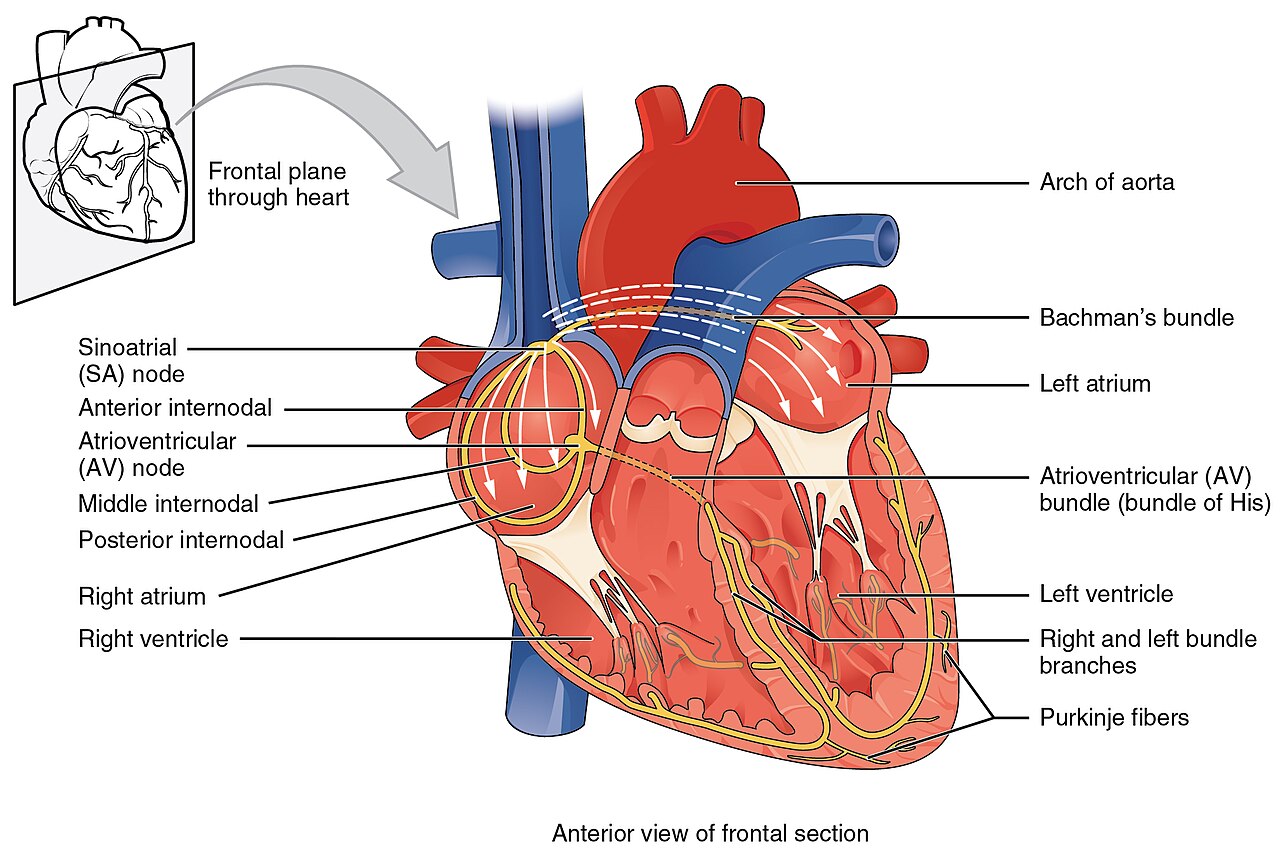
Trace conduction from the SA node through the AV node and His–Purkinje system. Connect electrical timing to the ECG and the cardiac-output discussion. Interpret a clinical rhythm from an ECG alongside the patient’s condition.
Electrical conduction system of the heart · OpenStax College (2013) · CC BY 3.0. Unchanged published raster preview; displayed responsively. Original available from the source. Original publication.
Recognise ischaemia and decompensation
Myocardial ischaemia can produce pressure-like chest pain with radiation, breathlessness, nausea or sweating, sometimes including jaw discomfort. New concerning symptoms during dentistry require stopping treatment, assessment and the emergency chest-pain pathway. Do not attribute them to anxiety before assessing physiology. Heart failure can limit tolerance of lying flat and fluid shifts; ask about worsening breathlessness and swelling rather than merely recording the diagnosis. Elective treatment may need postponement for medical assessment when disease is unstable. An urgent dental infection still needs a coordinated route, potentially in a setting able to manage both risks.
Reduce avoidable stress without withholding anaesthesia
Discuss previous experiences, agree a stop signal, use effective local anaesthesia and choose a manageable appointment length. Poor pain control can provoke a substantial endogenous sympathetic response, so avoiding all vasoconstrictor automatically is not a complete risk-reduction strategy. Select the local-anaesthetic preparation and dose according to the actual cardiac condition, interacting medicines and product guidance. Inject carefully and monitor the patient clinically. Significant arrhythmia, unstable disease or complex sedation needs may change the appropriate setting. A fixed cartridge limit applied to every cardiac patient cannot replace an individual assessment of exposure and reserve.
Keep antithrombotic and device questions distinct
Coronary stents often imply antiplatelet treatment, which must be identified and managed through the appropriate bleeding guidance. A stent is not itself an indication for endocarditis prophylaxis. For implanted electronic devices, establish the device type, indication and any advice relevant to equipment such as electrosurgery; obtain specialist advice where needed rather than banning all electrical dental equipment. Review orthostatic symptoms when raising the chair and make positional changes gradually. Consider interactions when prescribing analgesics or antibiotics. The cardiac diagnosis, device and medicines can affect different aspects of the same visit and should not be collapsed into one precaution.
Establish infective-endocarditis risk accurately
NICE's statement that prophylaxis is not routinely recommended is not an absolute ban. The March 2026 SDCEP advice distinguishes high-risk cardiac groups, including previous endocarditis and specified prosthetic valves or repairs, from moderate-risk conditions. Some devices and repaired congenital conditions have time-dependent or residual-defect qualifications, so use the actual cardiac record and current risk tables. Pacemaker-only status and ordinary degenerative valve disease fall within the moderate-risk advice; prophylaxis is not normally required unless the cardiac team specifies otherwise. Clarify uncertain anatomy or a conflicting cardiac recommendation before the dental procedure.
Link prophylaxis to the dental procedure
For a high-risk patient, current SDCEP advice is to offer prophylaxis before extraction and oral surgery and consider it for procedures manipulating gingival or periapical tissues. Explain potential benefit, adverse effects and uncertainty, incorporate oral health and patient preferences, and document the shared decision. Radiographs, non-infected local-anaesthetic injections and supragingival restorations do not automatically need prophylaxis. Check the current prescribing section for the chosen regimen, allergy, interactions and timing. A postoperative antibiotic course for an infection is a different indication and should not be substituted casually for the planned prophylactic regimen.
Prevention, documentation and review
Good daily plaque control and access to dental disease treatment are continuing parts of endocarditis prevention; a single antibiotic dose does not replace them. Explain why unexplained persistent fever or systemic illness in an at-risk patient warrants medical advice, particularly after a procedure. Record the cardiac information used, current symptoms, agreed setting, haemostatic plan and prophylaxis decision separately. Revisit the plan if cardiac treatment, functional capacity or oral health changes. Aim for reliable preventive and maintenance care that reduces repeated emergencies, while preserving a practical route for urgent dental treatment if the patient’s medical condition deteriorates.
A distinction to remember
Do not confuse a coronary stent or pacemaker with a prosthetic heart valve, or treat “not routinely” as a universal prohibition on prophylaxis.
A patient with a prosthetic aortic valve requires an extraction. Is “NICE says no antibiotics” an adequate plan?
Reveal the reasoning
No. Confirm the valve and apply the March 2026 SDCEP high-risk pathway. Offer prophylaxis before extraction, discuss benefits and harms with the patient, and check the current prescribing regimen and interactions. Document the decision and the separate bleeding plan.
Test your recall
Which cardiac symptoms should prompt reassessment before elective dental treatment?
Show answer
New or worsening chest pain, breathlessness, orthopnoea, syncope or loss of usual functional ability can indicate instability. Establish the pattern and urgency rather than relying on a historic diagnosis or one reassuring resting observation before proceeding with elective care.