
Primary tooth management
Retain comfortable, useful primary teeth where feasible, and remove sources of infection when necessary. The best option depends on lesion biology, remaining lifespan and what the child can accept.
Quick revision summary
Choose the least invasive feasible option
Assess lesion extent, pulpal status, restoratability, exfoliation timing and the child’s ability to cope. Sealing, selective removal and other strategies have different indications, and every lesion needs an active management plan.
A Hall crown needs a suitable tooth
A crown can seal an appropriate carious primary molar without conventional preparation. It is not a treatment for an infected tooth or a substitute for assessing symptoms, radiographs and proximity to the pulp.
Review the whole child
Balance durability and treatment burden with prevention, other affected teeth and family preferences. Explain the signs that require earlier review, and monitor whether the chosen approach remains comfortable, sealed and effective.
Common mistake
The Hall technique is a case-selected sealing treatment. It is unsuitable for a tooth with infection or signs of irreversible pulpitis, even when the child cannot tolerate drilling.
Primary tooth management
Retain comfortable, useful primary teeth where feasible, and remove sources of infection when necessary. The best option depends on lesion biology, remaining lifespan and what the child can accept.
Start with tooth identity, symptoms and prognosis
Primary enamel and dentine are thinner than in permanent teeth, and pulp horns lie relatively close to the surface. Caries can reach the pulp with apparently modest surface destruction. Primary molar roots surround the developing premolar; furcation infection and careless instrumentation therefore have consequences beyond the tooth being treated.
Ask about provoked versus spontaneous pain, sleep disturbance, food packing, swelling and previous episodes. Examine restorability, sinus, mobility and tenderness, and obtain justified images when they will change the plan. Physiological resorption and expected exfoliation affect the value of complex treatment. A primary tooth need not last indefinitely, but it should remain comfortable and free of infection.
Choose active control for the lesion present
An initial non-cavitated lesion may be managed with site-specific prevention, sealing or other suitable minimally invasive care. A cleansable cavity may be suitable for non-restorative cavity control if the child and carer can remove plaque and attend review. This is an active plan with a defined endpoint, not simply leaving the tooth until it hurts.
Silver diamine fluoride can arrest selected lesions and may help children unable to tolerate conventional care. Discuss permanent black staining of carious dentine and material-specific precautions before consent. It does not restore contour or treat a necrotic pulp. Review lesion hardness, plaque access and symptoms, and reconsider treatment if arrest is not achieved.
Proximal caries in primary molars
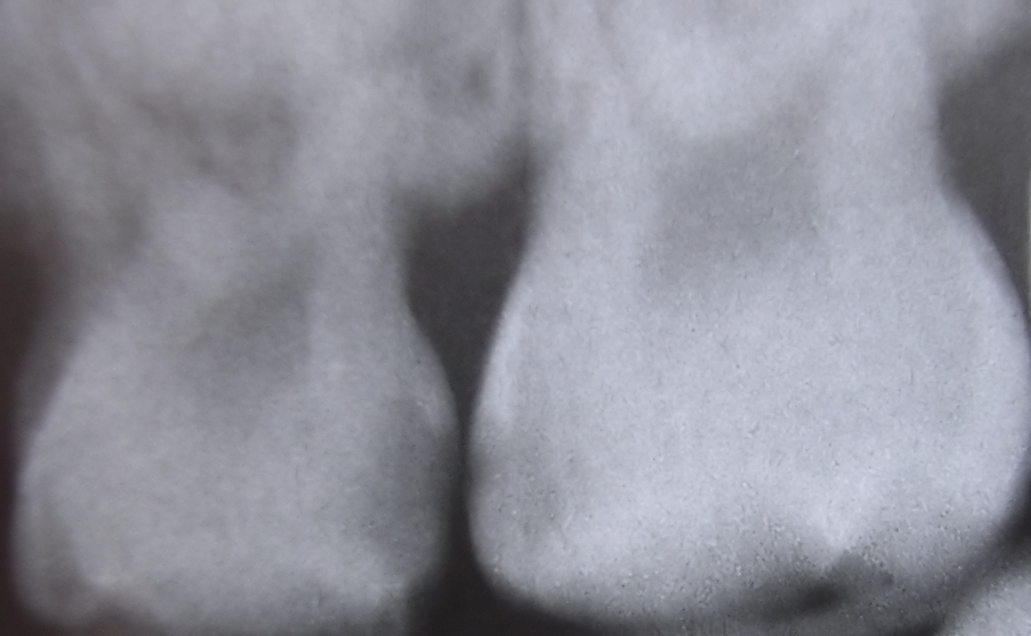
The source identifies interproximal caries between upper primary molars. Describe the radiolucent areas beneath the contact, then assess activity and cavitation clinically.
Interproximaldecayfiltered08-16-2006.jpg · Dozenist · CC BY-SA 3.0. Source author’s Neat Image processing retained. No additional image changes.
Seal rather than excavate every deep lesion
Selective caries removal aims to create sound peripheral margins for a durable restoration while avoiding unnecessary exposure near the pulp. The depth left over the pulp depends on the lesion and technique; it is not a justification for leaving a leaking restoration. Moisture control, sufficient restorative thickness and the child’s tolerance determine whether the seal is realistic.
For a vital, symptom-free primary molar with a suitable dentinal barrier and no infection, the Hall technique seals the lesion beneath a preformed metal crown without caries removal, tooth preparation or local anaesthesia. The crown must fit and seal. Separators may be needed for tight contacts, and a temporary bite increase is expected. Failed pulp diagnosis cannot be rescued by a well-fitting crown.
Match restoration durability to the tooth
A small accessible lesion may be treated with an adhesive restoration when isolation is adequate. Glass ionomer materials can be useful where moisture control is limited or as stabilisation, but wear and fracture affect longevity in large load-bearing lesions. A preformed metal crown can provide durable full coverage for a substantially affected primary molar.
Multi-surface restorations should protect the adjacent tooth during preparation. A small iatrogenic injury to an erupting first permanent molar can create a permanent problem. Explain appearance, expected lifespan and repair needs. A durable restoration may reduce repeated treatment, but only if the pulp, crown margins, remaining roots and overall plan support retention.
Recognise when pulp treatment or extraction is needed
SDCEP’s third edition allows pulpotomy for a restorable vital primary molar with irreversible symptoms and no dental abscess, where the child can tolerate treatment. This removes diseased coronal pulp and requires an appropriate medicament and a strong coronal seal. Symptoms alone do not make extraction compulsory, nor do they establish that the remaining radicular pulp is healthy.
A sinus, abscess, pathological mobility or inter-radicular radiolucency changes the diagnosis. Extraction is often appropriate; selected pulpectomy can be considered in suitable teeth through an appropriate service. Systemic antibiotics do not remove the source and are not indicated merely because a cavity is deep. Spreading infection or systemic illness needs urgent assessment and appropriate escalation.
Consider space, delivery and follow-up
An extraction decision includes the child’s experience, analgesia, anaesthesia, successor and space consequences. Avoid indefinite temporisation of an infected tooth while waiting for cooperation to improve. If definitive care needs sedation or general anaesthesia, agree interim symptom management, urgency and the complete treatment scope rather than sending an unprioritised list.
Review retained teeth for symptoms, crown/restoration integrity, lesion arrest and eruption. Record the tooth’s role in the whole-mouth plan. Early loss can alter space, but an appliance is not automatic; assess the dentition and follow-up burden. Local treatment remains paired with prevention so that erupting permanent teeth do not enter the same disease cycle.
A distinction to remember
The Hall technique is a case-selected sealing treatment. It is unsuitable for a tooth with infection or signs of irreversible pulpitis, even when the child cannot tolerate drilling.
A six-year-old has a large proximal primary-molar cavity, no symptoms and a clear dentinal separation from the pulp. Which options deserve discussion?
Reveal the reasoning
Assess restorability and radiographic findings, then compare a Hall crown, selective removal with restoration and appropriate cavity control. Cooperation and the ability to achieve a lasting seal matter. Explain appearance and review needs; large size alone does not mandate extraction.
Test your recall
Why can primary molar caries reach the pulp relatively quickly?
Show answer
The enamel and dentine are thin, and the pulp is relatively large with prominent horns. The visible cavity can underestimate pulpal proximity. Symptoms, examination and appropriate images should guide treatment rather than judging pulp status from surface size alone.