
Interceptive treatment
Interception treats a developing problem before it becomes more difficult. Select a specific objective, an appropriate developmental stage and a review plan; earlier treatment is not automatically better treatment.
Quick revision summary
Choose a defined interceptive objective
Interception aims to improve a developing problem, such as a functional crossbite or an ectopic eruption path. Establish the diagnosis and expected benefit before extracting teeth or prescribing an appliance.
Preserve future treatment options
Space, development, occlusion and the prognosis of all relevant teeth matter. Decisions about primary canines or compromised permanent molars should fit a wider plan, with specialist input when consequences are uncertain.
Check whether interception worked
Agree a review schedule and measurable signs of improvement. Explain that early treatment may reduce a problem without removing later orthodontic needs, and revise the plan if development or response differs from expectations.
Common mistake
Interception needs an identified mechanism and endpoint. Do not extract primary teeth or expand arches simply because a child is in mixed dentition.
Interceptive treatment
Interception treats a developing problem before it becomes more difficult. Select a specific objective, an appropriate developmental stage and a review plan; earlier treatment is not automatically better treatment.
Define the problem that interception can change
Useful objectives include removing an occlusal interference, guiding eruption, maintaining selected space, addressing an obstructing tooth or supporting a strategic extraction decision. The intervention should change a plausible mechanism. Treating a normal transition without evidence of benefit can add visits, appliance burden and risk without preventing later comprehensive care.
Use tooth identity, space, eruption sequence, facial relationship and growth to identify the problem. Ask what happens with observation and whether later treatment remains possible. Define success in measurable terms, such as disappearance of a functional shift or improvement of an ectopic tooth’s position, rather than a general promise of perfect alignment.
Class III: relationship schematic
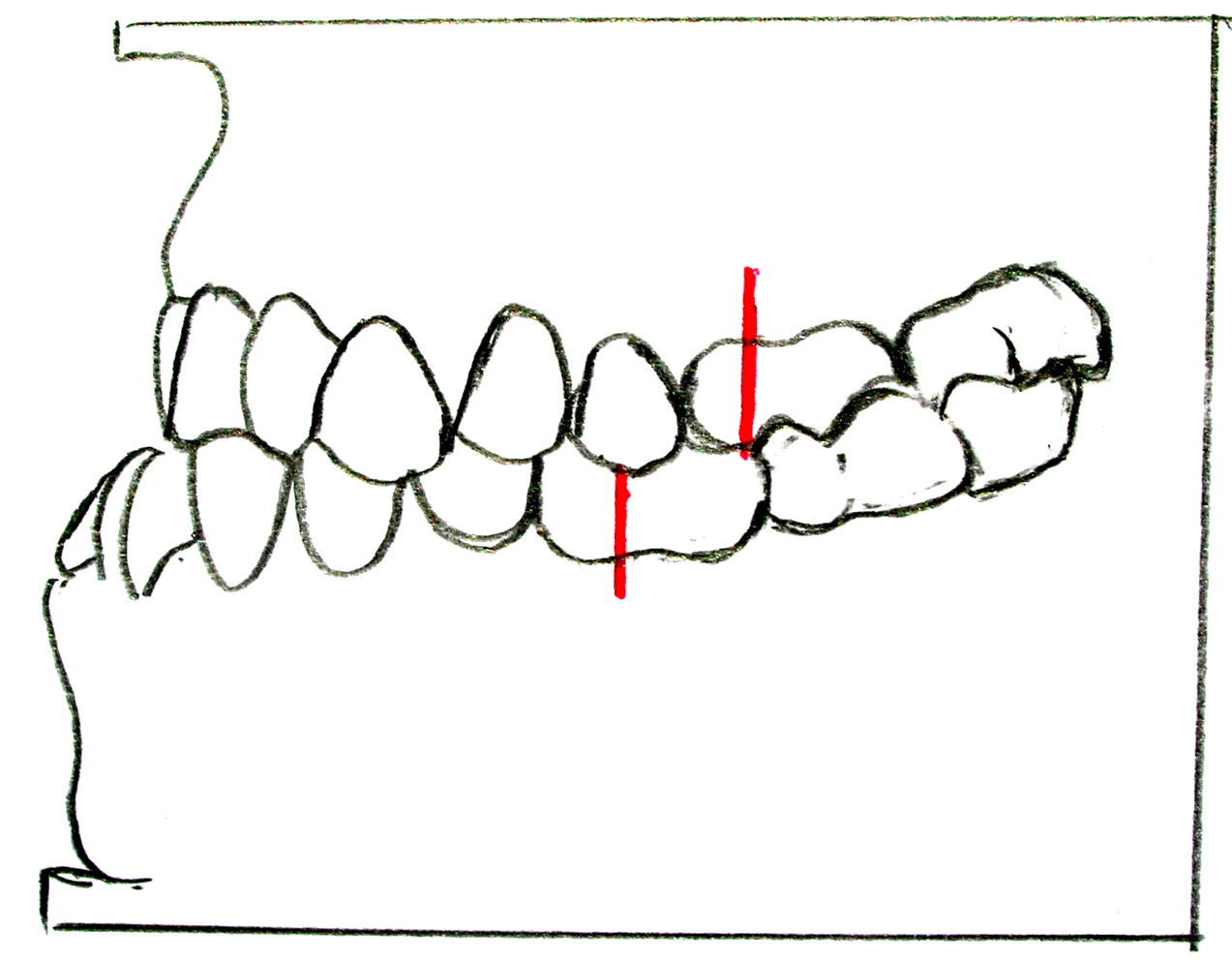
Compare the molar reference points with the Class II diagrams. The anterior relationship shown is a reverse overjet. A dental Class III relationship is not automatically proof of a skeletal Class III pattern: examine the facial profile and any functional displacement.
Zahnfehlstellung Angle-Klasse III.jpg · Dr. Georg Risse · CC BY-SA 3.0. None; original image reproduced without alteration.
Why assess the mandible on closure when a child has an anterior crossbite?
A functional forward displacement can create or exaggerate an apparent Class III relationship and influences diagnosis and referral.
Crossbites with displacement need timely assessment
In an anterior or posterior crossbite, compare the first tooth contact with the habitual bite and record any mandibular shift. A displaced closure can imitate or contribute to asymmetry. A local dental interference differs from a skeletal discrepancy; the relationship and available space guide whether a simple or more complex approach is appropriate.
Selected anterior dental crossbites can be corrected with an appropriate appliance where space, overbite and tooth position allow. Posterior correction may need expansion selected to the transverse problem. Do not prescribe indiscriminate expansion or attempt correction without considering the periodontal envelope and the underlying skeletal pattern. Refer when the required diagnosis or mechanics exceed competence.
Manage habits without blame
Persistent digit or dummy sucking can contribute to increased overjet, anterior open bite and posterior crossbite, depending on frequency, duration and intensity. Explore when the habit occurs and what comfort it provides. Avoid punishment or humiliation; involve a child who is developmentally able in an achievable stopping plan.
Some dentoalveolar effects may improve after the habit stops, particularly while development remains favourable, but spontaneous correction is not guaranteed. A habit-breaking appliance is a selected option after discussion, not an automatic response to every habit. Review motivation, mucosal comfort, oral hygiene and whether other contributors to the malocclusion remain.
Use eruption guidance selectively
A supernumerary tooth or odontome can obstruct an incisor. Localise it, assess space and root development, and plan removal when indicated with the relevant team. Some permanent teeth erupt after obstruction removal, while others require surgical exposure and traction. Counsel about both possibilities and monitor actual progress.
For a selected mildly palatally ectopic canine, primary-canine extraction may improve the eruption path. The effect is not certain and depends on position and space. It should follow specialist planning and structured review; extracting all retained primary canines without localisation is inappropriate. A canine near adjacent roots may require a different, more urgent plan.
Preserve or manage space with a full diagnosis
Premature primary tooth loss, first-molar ectopia, infra-occluded primary molars and hypodontia can alter arch development. A space maintainer preserves a chosen space but cannot recover space already lost. Assess the successor, crowding, eruption stage and appliance risks before choosing one. Maintaining every gap can conflict with a planned orthodontic space strategy.
Serial extraction is a carefully selected sequence for particular severe crowding patterns, not routine removal of primary teeth to tidy incisors. Poor-prognosis first permanent molars require separate coordinated decisions. Avoid balancing or compensating sound teeth automatically. The objective and full dentition must justify each irreversible extraction.
Monitor whether interception worked
Set a review interval appropriate to the objective and give clear return advice. Check space, tooth movement, displacement, appliance integrity, hygiene and tissue health. When the expected change does not occur, reconsider the diagnosis and move to a different strategy rather than extending the same intervention indefinitely.
Explain that interception can simplify later care without necessarily eliminating braces. Some skeletal problems remain growth-dependent and need long-term assessment. A successful short-term correction does not prove stable lifelong alignment. Record what was done and why so that the later orthodontist can understand extraction history, appliance effects and any remaining developmental concerns.
A distinction to remember
Interception needs an identified mechanism and endpoint. Do not extract primary teeth or expand arches simply because a child is in mixed dentition.
A nine-year-old has a unilateral posterior crossbite with a clear shift on closing. Why is this more than a cosmetic issue?
Reveal the reasoning
The displaced closure is a functional finding that warrants timely assessment. Determine the transverse problem and interference and consider appropriate correction rather than waiting automatically for full permanent eruption. Explain the objective, possible need for later comprehensive care and review requirements.
Guidance to read alongside this chapter
Test your recall
What makes an orthodontic intervention interceptive?
Show answer
It targets an identifiable developing problem before a more established malocclusion develops, such as an eruption obstacle or functional displacement. The defining feature is a plausible preventive or simplifying effect, not merely treatment delivered at a young age.