
Pulp and periapical tests
Use tests to build a pulpal assessment and a separate apical assessment. Most routine tests measure a response to a stimulus rather than directly displaying the pulp’s circulation or microscopic state.
Quick revision summary
Start with a question, controls and a baseline
Before testing, identify the symptom, suspected tooth and realistic alternatives. Inspect restorations, caries, cracks, colour, swelling and periodontal findings. Review trauma and previous treatment. The patient’s suggested tooth is a starting point, because pulpal pain can be referred and symptoms may arise from several nearby structures.
Percussion, palpation, mobility and probing
Compare gentle axial and, where useful, lateral percussion with control teeth. Tenderness can indicate inflammation in supporting tissues but may also relate to trauma, an occlusal high point or periodontal disease.
Discordant findings and follow-up
When tests disagree, repeat the technique, reassess controls and check whether the proposed tooth and diagnosis explain the full pattern. Trauma can transiently reduce sensibility; mixed vital and necrotic tissue, restorations or multi-rooted anatomy can also complicate interpretation.
Common mistake
Sensibility is not the same as vascular vitality. An absent cold response, an electrical threshold or a radiolucency must be interpreted with controls, history and the other findings.
Pulp and periapical tests
Use tests to build a pulpal assessment and a separate apical assessment. Most routine tests measure a response to a stimulus rather than directly displaying the pulp’s circulation or microscopic state.
Start with a question, controls and a baseline
Before testing, identify the symptom, suspected tooth and realistic alternatives. Inspect restorations, caries, cracks, colour, swelling and periodontal findings. Review trauma and previous treatment. The patient’s suggested tooth is a starting point, because pulpal pain can be referred and symptoms may arise from several nearby structures.
Explain the stimulus and agree how the patient will signal a response. Use suitable control teeth with comparable anatomy where possible, testing them before the suspect tooth. Controls establish the patient’s response and help identify technique problems. Record the response quality, duration and reproducibility rather than reducing every result to an unexplained plus or minus.
Tooth & supporting tissues
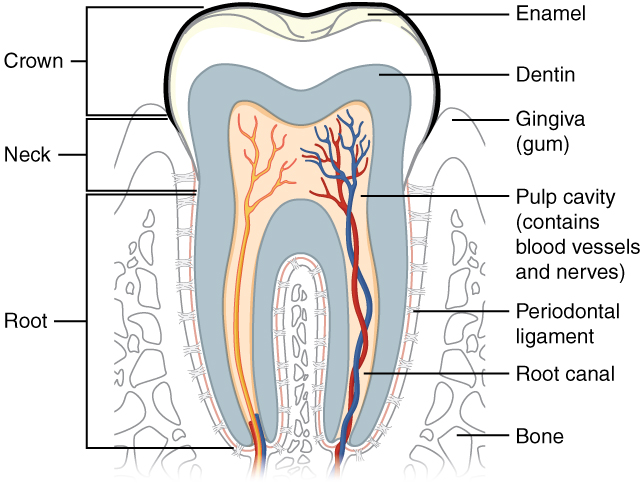
Trace the pulp and root canal to the apical region, then identify the periodontal ligament and supporting bone. Relate these structures to avulsion, apical pathology and extraction. The original uses the spelling “dentin”; cementum is not separately labelled.
Tooth & supporting tissues · OpenStax College · CC BY 3.0. Original image; displayed at a responsive size. Original publication.
Cold testing: neural response in context
Cold stimulates pulpal sensory nerves through thermal and dentinal mechanisms. Isolate and dry appropriately and apply the chosen cold stimulus to tooth structure using a reproducible technique without unnecessarily contacting gingiva or adjacent teeth. Record onset, intensity relative to controls and how long the response persists after removal.
A normal brief response, an exaggerated lingering response and no response have different implications, but none alone measures the precise histological boundary of disease. Recent trauma, immature teeth, calcification, thick restorations and poor stimulus delivery can change results. Strong symptoms with a confusing test deserve reassessment rather than automatic irreversible treatment.
Electrical tests, heat and vascular methods
Electrical pulp testing stimulates sensory fibres. Good contact, isolation and a suitable conductive interface matter; current can spread through metal or moist tissues and produce a response from somewhere else. The numerical threshold is not a direct scale of pulp health. A responsive tooth can still have disease, and an absent response needs interpretation.
Heat testing can help reproduce a specifically heat-triggered complaint when appropriately selected and performed without injury. Methods assessing blood flow, such as laser Doppler or pulse oximetry, address vitality more directly but have equipment, contamination and interpretation limitations. They are not equivalent to routine sensibility tests or a substitute for the whole assessment.
| Test | What it principally assesses | Important limit |
|---|---|---|
| Cold / electric | Pulpal sensory responsiveness | Does not directly measure vascular vitality or histology |
| Percussion | Response of periodontal supporting tissues to loading | Does not establish pulp status |
| Apical palpation | Tenderness or swelling in adjacent tissues | A normal response does not exclude early disease |
| Bite test | Load-related symptoms from a tooth or cusp | A painful response is not specific to one cause |
| Radiograph | Mineralised tissues and visible disease pattern | Early apical inflammation may be radiographically occult |
Percussion, palpation, mobility and probing
Compare gentle axial and, where useful, lateral percussion with control teeth. Tenderness can indicate inflammation in supporting tissues but may also relate to trauma, an occlusal high point or periodontal disease. Palpate the vestibule over root apices for tenderness, swelling or a sinus opening and assess the actual soft-tissue extent.
Mobility and site-specific periodontal probing add support information. A narrow isolated deep pocket can raise concern for a structural defect, while a broader pattern suggests different periodontal considerations. Neither pattern is pathognomonic. Trace a sinus tract or perform additional tests only where indicated and with a technique that answers a specific question.
Cracks, bites and the role of imaging
A bite test can examine individual cusps and distinguish pain during loading from release. Magnification, transillumination and inspection after appropriate restoration removal may reveal a crack, but visible lines differ in significance and do not establish the full depth. Correlate symptoms, pulpal response and periodontal findings before deciding prognosis.
Justified periapical imaging assesses roots, canal appearance, periodontal ligament space, lamina dura and surrounding bone. A radiolucency near an apex is not automatically endodontic: relate it to pulp status, normal anatomy, lesion margins and neighbouring teeth. Early apical inflammation may show no obvious bone change. Additional views or CBCT need a decision-changing question, not routine escalation.
Integrate a pulpal and an apical assessment
Pulpal categories describe a clinical judgement about the pulp, while apical categories describe supporting-tissue status. A tooth can respond to cold and have symptomatic apical inflammation; a root-filled tooth can have healthy or diseased apical tissues. Previous endodontic treatment must be stated because it changes the interpretation of sensibility testing.
Terms such as reversible and irreversible pulpitis are clinical categories and do not perfectly map symptoms onto microscopic healing potential. Contemporary vital-pulp approaches and diagnostic terminology continue to evolve. Use the terminology adopted by the relevant training or clinical framework, preserve the actual findings and avoid presenting a symptom threshold as a definitive histological test.
Discordant findings and follow-up
When tests disagree, repeat the technique, reassess controls and check whether the proposed tooth and diagnosis explain the full pattern. Trauma can transiently reduce sensibility; mixed vital and necrotic tissue, restorations or multi-rooted anatomy can also complicate interpretation. Review timing and the full injury-specific follow-up plan matter.
Document a provisional conclusion and uncertainty where appropriate. Arrange review or specialist assessment when localisation is unreliable or the consequence of error is high. Repeated irreversible treatment of normal teeth is a serious consequence of forcing an uncertain pain presentation into a dental diagnosis. A clear test record supports reassessment far better than an unexplained label.
A distinction to remember
Sensibility is not the same as vascular vitality. An absent cold response, an electrical threshold or a radiolucency must be interpreted with controls, history and the other findings.
An immature incisor has no cold response two days after trauma, but no other sign of necrosis is present. Does the test alone justify diagnosing pulp necrosis?
Reveal the reasoning
No. Trauma and immature innervation can make early sensibility testing unreliable. Record the baseline, compare controls and use the appropriate injury-specific clinical and radiographic follow-up. A single early absent response does not establish the entire pulpal condition.
Test your recall
What do cold and electrical pulp tests usually measure?
Show answer
They assess sensory nerve responsiveness rather than directly measuring pulpal blood flow. A response supports neural function but cannot prove normal histology. An absent response needs context because technique, maturation, trauma and structural changes can affect the result.