
Acute dental pain
Pain relief starts with a diagnosis and a check for dangerous disease or medicine exposure. Establish the source, provide appropriate local treatment and use an analgesic plan suited to the person.
Quick revision summary
Locate the source of pain
Use the history, examination and appropriate tests to distinguish pulpal, apical, periodontal and non-dental causes. Referred pain and misleading localisation mean that the tooth the patient points to is not automatically the source.
Treat the mechanism
Provide appropriate local treatment and analgesia for the established diagnosis. Antibiotics do not resolve uncomplicated pulpitis or replace drainage and source control, and persistent pain warrants reassessment rather than repeated empirical prescriptions.
Identify urgency and review
Swelling, systemic illness, swallowing difficulty or airway symptoms change the pathway. Explain expected recovery and specific reasons to seek help, with a practical follow-up route if pain persists or the working diagnosis remains uncertain.
Common mistake
The most painful tooth is not always the source, and pain relief does not establish that infection or pulpal disease has been treated.
Acute dental pain
Pain relief starts with a diagnosis and a check for dangerous disease or medicine exposure. Establish the source, provide appropriate local treatment and use an analgesic plan suited to the person.
Identify urgent threats before concentrating on the tooth
Ask about swelling, difficulty swallowing, breathing or speaking, eye symptoms, trauma and systemic illness. Severe trismus, floor-of-mouth swelling or physiological deterioration changes the route of care even if the patient describes toothache. Establish how rapidly symptoms are progressing and whether the patient can eat and drink. Jaw discomfort associated with exertion, chest symptoms or breathlessness may be non-dental and requires the appropriate medical assessment. Pain intensity alone does not classify infection severity: severe pulpitis can occur without spreading infection, while an immunocompromised person may have dangerous infection with surprisingly modest pain or swelling.
Stages and threshold of an action potential
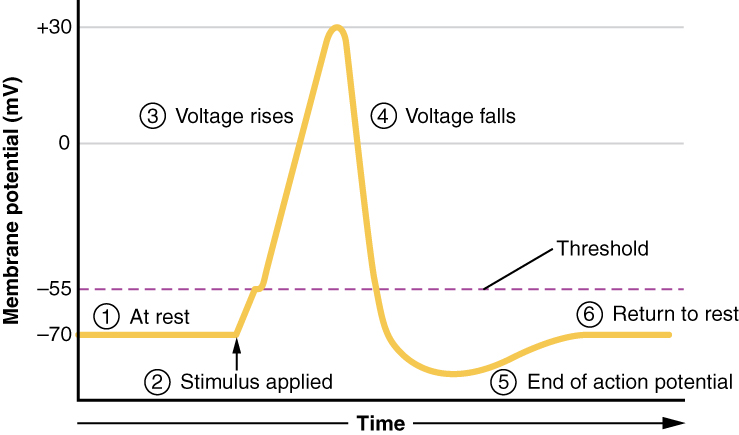
Trace threshold, depolarisation, repolarisation and after-hyperpolarisation. Recall sodium-channel opening during the rising phase and relate sodium-channel blockade to local anaesthesia. The plotted voltages illustrate a representative cell.
Stages and threshold of an action potential · OpenStax (Anatomy and Physiology, 2016 version) · CC BY 4.0. Unchanged published image; displayed responsively. Original publication.
Build a useful pain history
Ask the patient to describe the pain in their own words, then clarify site, onset, duration, triggers, radiation, spontaneous episodes and response to previous treatment. Brief stimulus-related sensitivity differs from prolonged thermal pain or spontaneous nocturnal episodes. Pain on biting suggests a different tissue response from an isolated response to cold, but no symptom is diagnostic alone. Establish recent restorations, trauma, extraction, orthodontic change and previous similar episodes. Record what medicines have already been taken, when and in what quantity. A patient may unknowingly combine several products containing the same active ingredient while trying to obtain relief.
Test a working diagnosis rather than one favoured tooth
Examine extraorally and intraorally, including mucosa, periodontal tissues, occlusion and adjacent teeth. Combine cold or other sensibility tests, percussion, palpation, probing and appropriate imaging according to the clinical question. Compare with control teeth and recognise that sensibility tests assess neural response, not direct pulpal blood supply. Pulpal pain can be poorly localised or referred; tenderness to percussion reflects periodontal inflammation and does not by itself establish a necrotic pulp. A crack may require focused bite testing and careful assessment. Do not perform irreversible treatment solely because a radiograph contains an old restoration near the reported pain.
Match local treatment to the cause
For a reversible irritant, remove the cause and provide a protective restoration with review. A tooth with irreversible pulpal disease may require appropriate pulp treatment, root-canal care or extraction according to diagnosis, restorability and consent. An abscess needs drainage and source control; a periodontal source needs the relevant local treatment. Post-extraction pain requires assessment for alveolar osteitis, infection, trauma or another cause rather than being labelled automatically. Explain what has been completed and what remains outstanding. Temporary access or an emergency dressing should be followed by an explicit completion plan, not treated as indefinite definitive care.
Use analgesics as an adjunct
Paracetamol and an appropriate NSAID can be useful for odontogenic inflammatory pain, but selection depends on contraindications, interactions and current prescribing guidance. Review renal and hepatic disease, gastrointestinal bleeding, cardiovascular risk, anticoagulants, pregnancy and previous NSAID-triggered respiratory or allergic reactions. Do not combine two NSAIDs or allow duplicate paracetamol through combination remedies. Check the actual dose and timing already taken; suspected excess exposure needs urgent poisons or medical assessment even if the patient feels well. Opioids are not a routine solution to untreated dental disease and introduce sedation, dependence and interaction risks.
Know when antibiotics will not solve the problem
Antibiotics do not provide the required treatment for irreversible pulpitis and are not routinely indicated for uncomplicated alveolar osteitis. A localised abscess should be managed with drainage and removal of the cause where possible. Spreading infection, systemic involvement or inability to achieve immediate drainage may justify antibiotics in the appropriate assessment, but the source-treatment plan remains necessary. Record the actual indication and review response. Failure to improve should prompt reassessment of diagnosis, drainage and host factors rather than automatic progression through broader agents. Explain this reasoning to the patient so that declining unnecessary antibiotics does not sound like declining pain care.
Reassess discordant or persistent pain
If the history, tests and response do not fit, reconsider referred muscular pain, sinus disease, neuralgic pain, persistent dentoalveolar pain and other non-odontogenic causes. Avoid serial extractions as diagnostic tests. Explain uncertainty and arrange the appropriate review or referral while maintaining suitable symptom support. Give a clear route for increasing swelling, swallowing difficulty, systemic illness, uncontrolled bleeding or inability to maintain intake. Record the diagnosis, treatment, medicine exposure and follow-up. A reduction in pain after analgesia is welcome but does not prove that the causative disease has resolved or that definitive care can be abandoned.
A distinction to remember
The most painful tooth is not always the source, and pain relief does not establish that infection or pulpal disease has been treated.
A patient has spontaneous night pain and a prolonged cold response from a heavily carious molar, but no swelling or systemic illness. What should treatment target?
Reveal the reasoning
The findings support significant pulpal inflammation, interpreted with the full examination and imaging. Provide appropriate local pulp treatment or extraction according to diagnosis and restorability, with suitable analgesia. Antibiotics alone do not treat irreversible pulpitis.
Test your recall
Which features of toothache change the urgency beyond ordinary dental pain management?
Show answer
Breathing, swallowing or speaking difficulty, floor-of-mouth swelling, severe trismus, eye symptoms or systemic deterioration require urgent assessment and possible emergency transfer. Evaluate progression and physiology rather than assuming that severe pain and severe infection are the same thing.