
Deterioration and medical emergencies
Recognise the patient who needs help before the diagnosis is certain.
What to expect
An acutely unwell patient may be in a clinic chair, ED cubicle or ward bed. DCTs need to know the hospital emergency call, resuscitation equipment and who leads the response. Clinical urgency is set by physiology and trajectory, not by whether the problem belongs to OMFS.
What to know
Use ABCDE, current observations and the local early-warning score. Consider airway obstruction, sepsis, haemorrhage, anaphylaxis, hypoglycaemia, syncope, seizure and chest pain. Treat according to current Resuscitation Council UK and trust protocols, within training; call for help early. Reassess after each intervention and communicate changes to the responding team.
A practical approach
State the immediate concern and location in the emergency call. Allocate tasks such as oxygen/monitoring, glucose or observations as directed by the team. Document the timeline, treatments, response and handover. After a near miss or emergency, debrief and check whether equipment, training or processes need improvement.
Safety point
Do not wait for rash to appear when airway/breathing/circulation features suggest anaphylaxis, and do not give oral glucose to someone unable to swallow safely.
ABCDE, collapse and adult basic life support
Recognise deterioration, summon help and support physiology immediately. A diagnosis can be refined while treatment proceeds; repeated reassessment shows whether the response is working.
The structured first response
| Step | Assessment focus | Action principle |
|---|---|---|
| A — Airway | Patency, voice, obstruction and contamination | Open / maintain the airway using trained measures; call appropriate help early. |
| B — Breathing | Rate, depth, effort, chest movement and oxygenation | Support oxygenation and ventilation; assess the patient as well as the monitor. |
| C — Circulation | Pulse, perfusion, blood pressure and bleeding | Treat the cause and recognise shock / inadequate circulation. |
| D — Disability | Conscious state, seizure activity and glucose when relevant | Consider reversible causes and protect the patient. |
| E — Exposure / context | Rash, injury, medicines, cannula and other clues | Identify a likely cause while maintaining dignity and reassessing ABC. |
Electrical conduction system of the heart
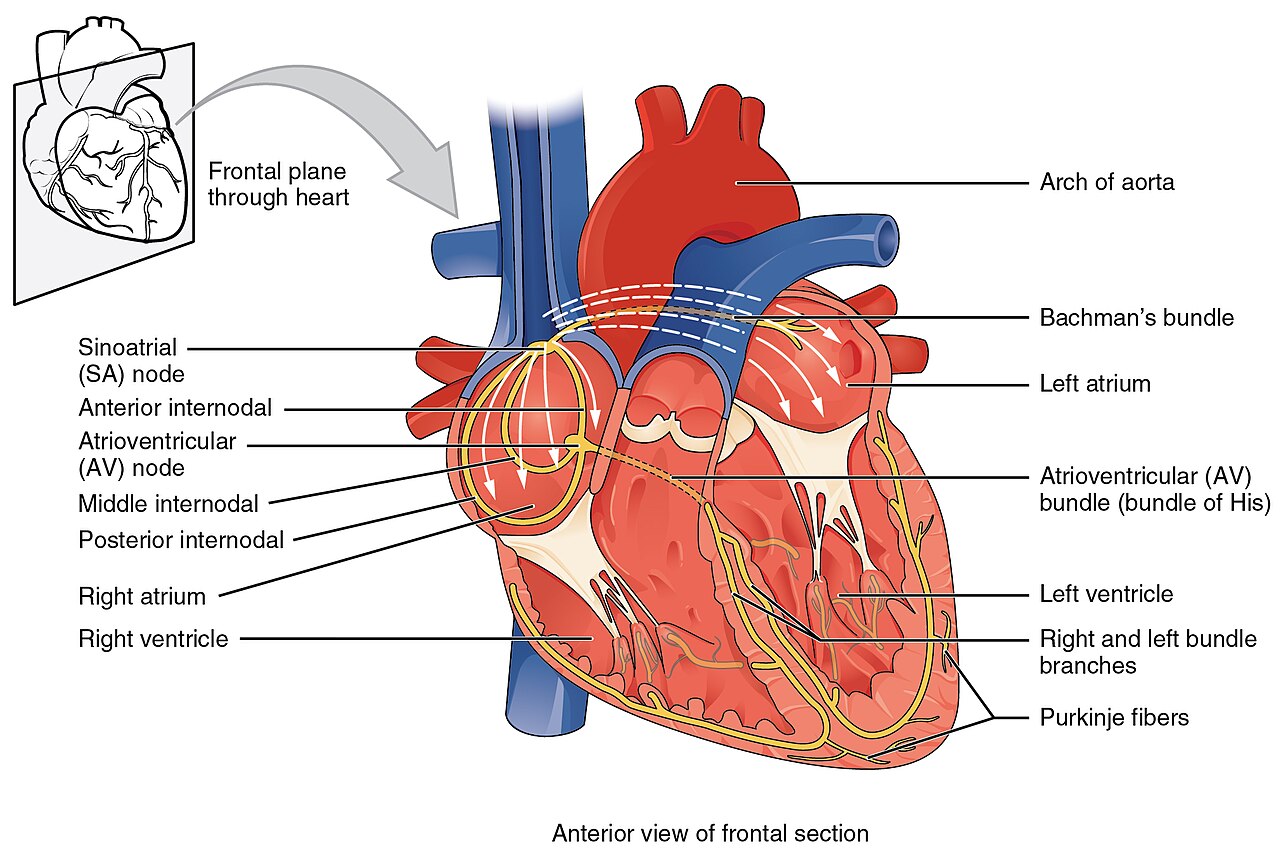
Trace conduction from the SA node through the AV node and His–Purkinje system. Connect electrical timing to the ECG and the cardiac-output discussion. Interpret a clinical rhythm from an ECG alongside the patient’s condition.
Electrical conduction system of the heart · OpenStax College (2013) · CC BY 3.0. Unchanged published raster preview; displayed responsively. Original available from the source. Original publication.
Adult BLS: use the emergency response for the setting
In hospital, shout for help, assess responsiveness and normal breathing, and activate the resuscitation or medical emergency team through the local emergency call system. If there are no signs of life or there is doubt, start CPR and obtain the defibrillator; team members perform these actions concurrently when possible. In dental practice or the community, the 2025 BLS sequence is to call 999 immediately for an unresponsive person, then assess breathing while the call is connecting. Abnormal gasping is not normal breathing.
Adult chest compressions are 100–120 per minute, 5–6 cm deep, with full recoil and minimal interruptions. If trained to provide breaths, use 30 compressions to 2 breaths and give only enough air for the chest to rise. Attach an AED as soon as available and follow its prompts. Continue according to the current BLS pathway and emergency team instructions.
Do not call every collapse a faint
A vasovagal episode commonly has a trigger and prodrome such as pallor, sweating and nausea, with improvement after appropriate positioning. Failure to recover promptly, abnormal breathing, chest symptoms, rash / airway change, seizure, metabolic features or an abnormal rhythm requires another explanation and escalation.
Know the location and operation of the emergency equipment and how colleagues call for help and divide tasks. Record timings, medicines and responses. Rehearsed team roles make the first response more reliable than remembering an isolated medicine dose.
Collapse: response depends on consciousness and breathing
Unresponsive
- Summon help and assess responsiveness / breathing
- Activate the hospital resuscitation team; use 999 in the community
- No signs of life or doubt: CPR and defibrillator
Conscious but deteriorating
- Stop treatment and call appropriate help
- Assess and treat ABCDE findings
- Reassess and escalate the cause
Apparent faint
- Use appropriate positioning and assessment
- Look for prompt recovery
- Persistent / atypical findings require escalation
Adult revision pathway. Use the hospital in-hospital resuscitation algorithm at work; community BLS and paediatric algorithms have different setting-specific details.
A distinction to remember
Know the local hospital emergency call system before starting a shift. An emergency call, CPR and collecting equipment should proceed concurrently when staff are available; agonal gasps are not reassuring breathing.
A patient is unresponsive and intermittently gasps. Does the gasping remove the need for CPR?
Reveal the reasoning
No. Abnormal gasping is not normal breathing. Summon the appropriate emergency team, start CPR when there are no signs of life or there is doubt, and apply the defibrillator promptly. In hospital use the local resuscitation call; in the community call 999.
Guidance to read alongside this chapter
Recognising and treating anaphylaxis
Anaphylaxis is a clinical diagnosis involving potentially life-threatening airway, breathing or circulation compromise. Skin findings may help but can be absent.
Recognise the pattern
| Domain | Possible finding | Why it matters |
|---|---|---|
| Airway | Swelling, hoarseness, stridor or difficulty speaking | Potentially rapidly progressive obstruction. |
| Breathing | Wheeze, respiratory distress or hypoxaemia | Airflow and gas-exchange compromise. |
| Circulation | Hypotension, collapse, pallor or poor perfusion | Shock; positioning and prompt treatment are critical. |
| Skin / mucosa | Urticaria, flushing or angioedema | Supportive finding, but absence does not exclude anaphylaxis. |
| Timing / exposure | Sudden deterioration after a plausible trigger | Supports the pattern; a previous allergy label is not required. |
Larynx: anterior and right lateral views
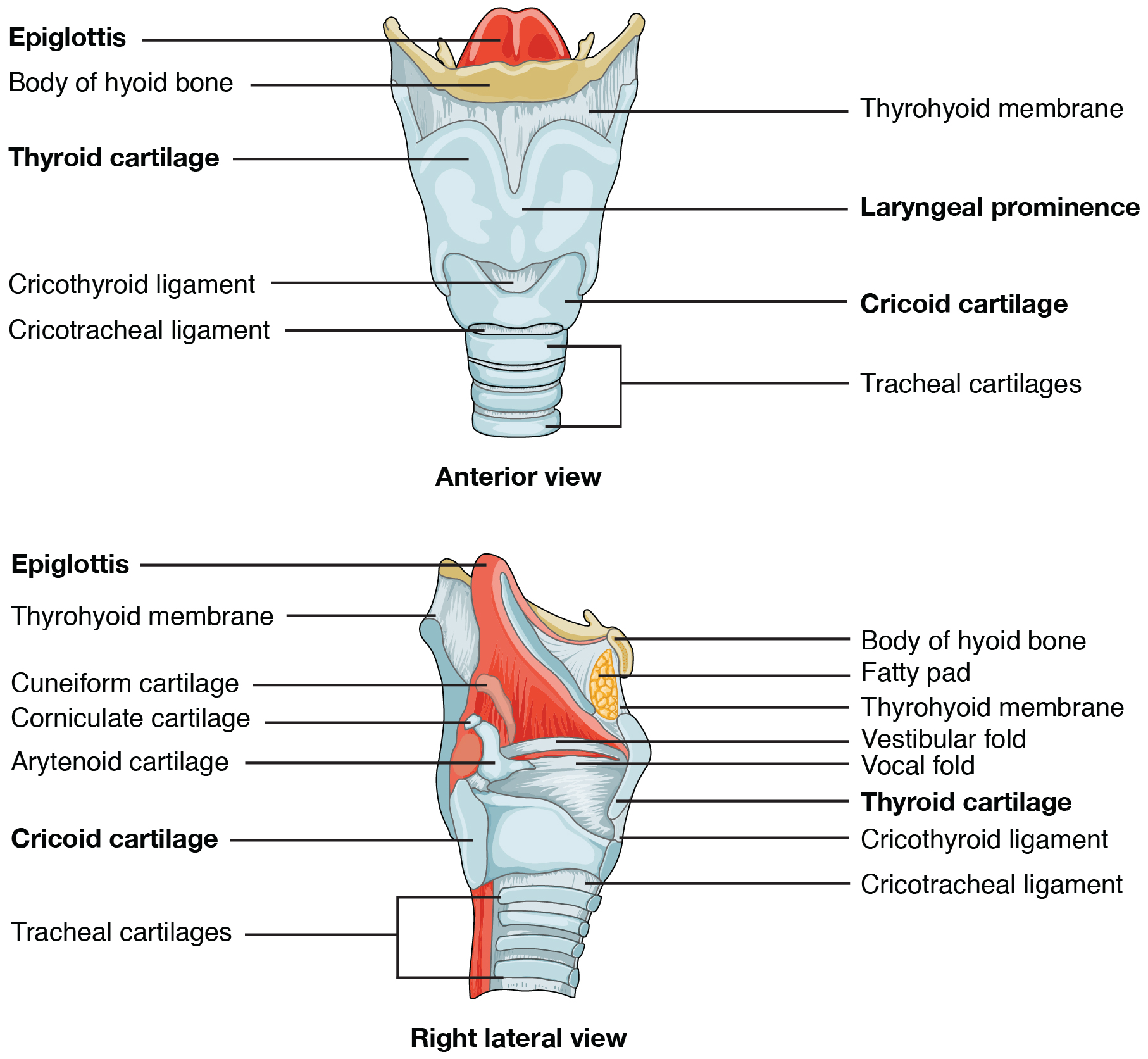
Locate the epiglottis, vocal folds, laryngeal cartilages and cricothyroid region. Relate the landmarks to airway anatomy in sedation and emergency assessment. Review tongue and pharyngeal obstruction in the accompanying lesson.
Larynx: anterior and right lateral views · OpenStax College (2013) · CC BY 3.0. Unchanged published image; displayed responsively. Original publication.
Adult first-line medicine and support
Call for emergency help, stop the suspected trigger where feasible and support ABC. The adult first-line dose is IM adrenaline 500 micrograms, equivalent to 0.5 mL of 1 mg/mL solution, into the anterolateral thigh. Repeat after five minutes if life-threatening problems persist, alongside the current emergency pathway.
Position for the physiology: avoid allowing the patient to stand or walk; use lying / leg elevation for circulatory compromise, adapting when breathing or other circumstances require it. Provide trained airway, oxygen and circulatory support. IV adrenaline belongs to appropriately experienced specialist care; do not confuse its use with the initial IM treatment.
Adjuncts and subsequent care
Antihistamines do not treat life-threatening airway or circulation problems and must not delay adrenaline. Steroids are not the immediate first-line treatment for anaphylactic compromise. Continuing or refractory problems require specialist management rather than repeated reassurances that a rash has improved.
Record trigger candidates, timing, dose / route, physiological findings and response. The patient needs appropriate transfer, observation and follow-up because recurrence or biphasic deterioration can occur. Document and communicate the allergy / adverse-reaction assessment without pretending that the exact trigger is always immediately certain.
Treat the physiological threat, not only the rash
Recognition
- Sudden airway, breathing or circulation problem
- Plausible exposure ± skin change
- Suspect anaphylaxis and call emergency help
First-line treatment
- Adult IM adrenaline 500 micrograms
- Support ABC and position appropriately
- Repeat after 5 minutes if problems persist
Ongoing care
- Reassess response and escalation needs
- Arrange transfer / observation
- Record trigger, treatment and follow-up
Adult dose only. Use the current full protocol for children, refractory reactions and specialist treatment.
A distinction to remember
No rash does not mean no anaphylaxis. Antihistamines are not a substitute for IM adrenaline when airway, breathing or circulation is compromised.
How many millilitres of 1 mg/mL adrenaline contain the adult 500-microgram IM dose?
Reveal the reasoning
500 micrograms = 0.5 mg. At 1 mg/mL, the volume is 0.5 mL. Verify the formulation and route; concentration confusion is a major error risk.
Guidance to read alongside this chapter
Test your recall
Which findings justify immediate escalation even before the diagnosis is confirmed?
Show answer
ABCDE abnormalities, physiological observations and a worsening trajectory.